Start with what is already running: a benchmarked GPU cluster, a GPU installation with heat reuse planned and a decade of HPC operations. Then match a supported configuration to your workload, facility and service team.
BENCHMARK / JUNE 2024
512IMMERSED H100s IN ONE MLPERF RUN
AI training at cluster scale.
SMC submitted MLPerf Training v4.0 results on immersion-cooled clusters of up to 512 H100 GPUs, with energy metered at the rack. Facility energy is excluded.
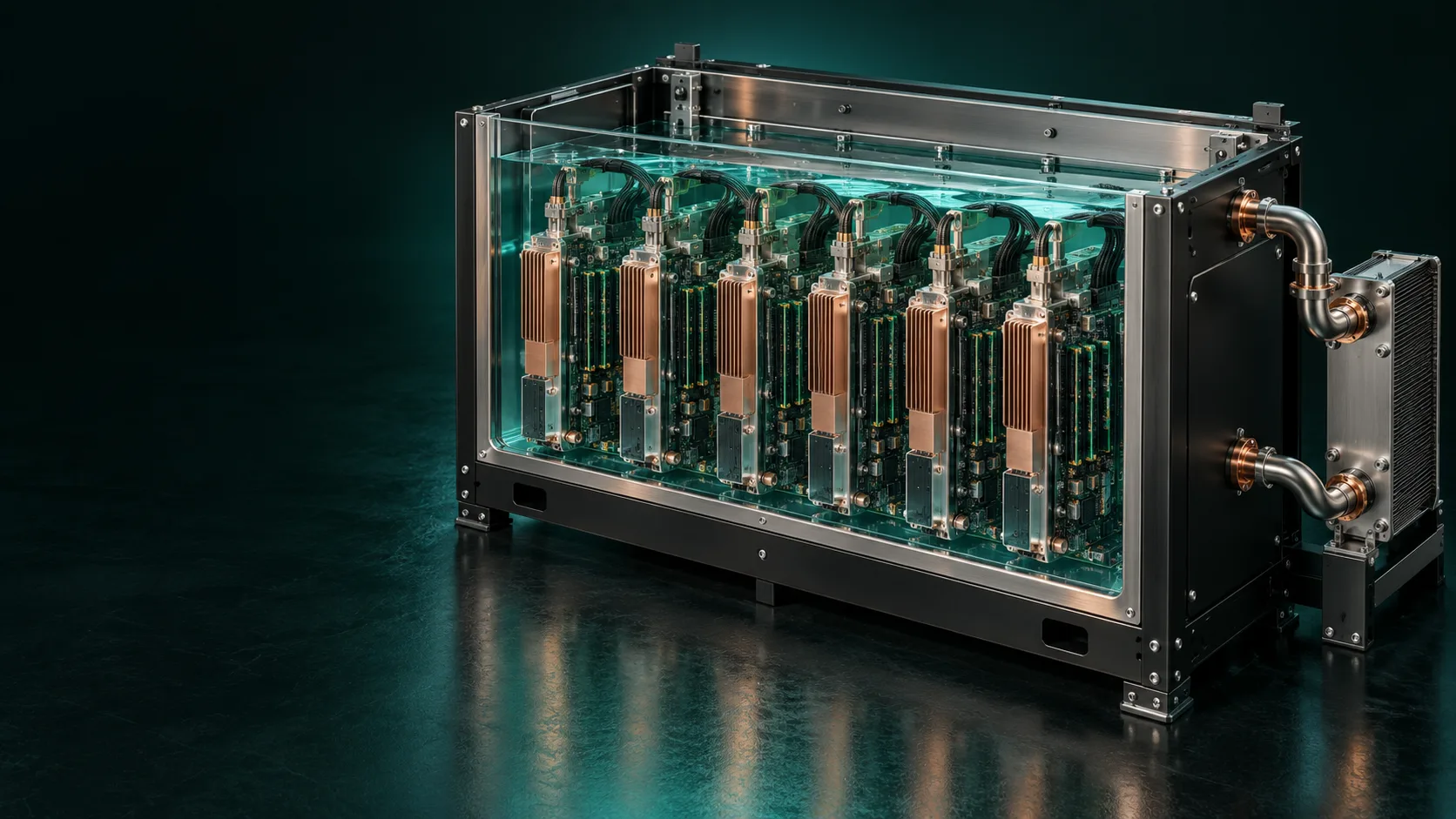
SMC runs an NVIDIA H100 GPU cloud in Singapore in its single-phase immersion HyperCubes, with SXM nodes on InfiniBand RDMA for training and inference. In June 2024 it submitted MLPerf Training v4.0 results on immersion-cooled clusters of up to 512 H100s, with the first full-system power measurements MLPerf Training had published. SMC reports 468 kWh for its GPT-3 175B benchmark run.
In November 2024, 2CRSi reported supplying Exaion, an EDF Group subsidiary, with an immersion tank and about thirty servers carrying more than 100 NVIDIA L40S GPUs for AI work at a Canadian data center. The release, which includes a statement from Exaion’s CEO, describes plans to reuse the heat for neighborhood heating and hot water.
Supplier announcement with a customer statement; no uptime or throughput figures published. Exaion installation ↗
OPERATOR ACCOUNT / CHECKED OCTOBER 2026
10+YEARS IN PRODUCTION
HPC has a long operating record.
DUG reports more than a decade of production immersion use. TACC also documents immersed CPU compute; its GPU nodes are air-cooled.
DUG reports more than ten years of production use of its immersion design in its own data centers. At TACC, about 70% of the Lonestar6 supercomputer went into four immersion tanks. The immersed nodes are CPU compute; all 88 GPU nodes sit in air-cooled racks.
Hypertec’s TRIDENT iGW610R-G6 takes up to four PCIe GPUs, including NVIDIA RTX PRO 6000 Blackwell and H200 NVL, in a 21-inch, 1U single-phase immersion server. 2CRSi catalogs an eight-GPU immersion platform with H200 NVLink support and a manufacturer warranty for qualified immersion use.
Catalog listings, not deployment accounts. PCIe support does not extend to HGX B200/B300 or GB300 NVL72; confirm the exact platform, fluid and warranty terms. Blackwell-capable server ↗ · Eight-GPU platform ↗
Rack-scale NVLink: know where it fits today.
NVIDIA describes its flagship GB300 NVL72 as a fully liquid-cooled rack, and builders ship it with direct liquid cooling and coolant distribution units. No public source reviewed here shows immersion support for these racks. Immersion’s record today is in CPU HPC, PCIe GPU servers and eight-GPU systems from builders that qualify them for the tank. If your roadmap is rack-scale NVLink, plan for the cooling that platform supports.
In an immersion system, the fluid cools every component in the bath, not only the processors. Follow the heat from the board to the facility, and see what has to be qualified along the way.
FOLLOW THE HEAT01 / COMPONENT COVERAGE
01 / COMPONENT COVERAGE
Start at the components.
Dielectric fluid surrounds the server and draws heat directly from processors, memory and voltage regulators, so the server fans come out. Everything in the bath must be compatible with the fluid: connectors, cables, labels and thermal interface materials.
Illustration: a single-phase immersion tank, with server boards submerged in dielectric fluid, a pump and an external heat exchanger. Stage 1 highlights immersed components. Copper lines show warmer fluid; teal lines show the cooler return.
Single-phase immersion. Colored paths trace the heat.FIG. 01
Warmer fluidCooler return
02 / THE WORKING FLUID
Let the fluid carry the heat.
In single-phase immersion, the fluid stays liquid and is pumped through the tank. Two-phase systems let the fluid boil on hot surfaces and condense on a coil above the bath. The two use different fluids, tanks and service practices.
Illustration: a single-phase immersion tank, with server boards submerged in dielectric fluid, a pump and an external heat exchanger. Stage 2 highlights liquid circulation. Copper lines show warmer fluid; teal lines show the cooler return.
Single-phase immersion. Colored paths trace the heat.FIG. 01
Warmer fluidCooler return
03 / HEAT TRANSPORT
Close the loop.
Warm fluid passes through a heat exchanger, hands its heat to a separate facility water loop and returns cooler to the tank. The dielectric stays on its own side of the exchanger. Qualify the server, fluid and tank as one working combination.
Illustration: a single-phase immersion tank, with server boards submerged in dielectric fluid, a pump and an external heat exchanger. Stage 3 highlights warmer fluid traveling to the exchanger and a cooler return. Copper lines show warmer fluid; teal lines show the cooler return.
Single-phase immersion. Colored paths trace the heat.FIG. 01
Warmer fluidCooler return
04 / HEAT REJECTION & OPERATIONS
The tank is part of a system.
The heat still has to leave the building through dry coolers, cooling towers or chillers, or go to a heat-reuse customer. Pumps, monitoring and service access belong in the design from the start. Immersion changes the heat path; the whole installation decides how well it runs.
Illustration: a single-phase immersion tank, with server boards submerged in dielectric fluid, a pump and an external heat exchanger. Stage 4 highlights a separate facility loop carrying heat toward external rejection. Copper lines show warmer fluid; teal lines show the cooler return.
Single-phase immersion. Colored paths trace the heat.FIG. 01
Warmer fluidCooler return
02 / THE ECOSYSTEM · FREE TO PARTICIPATE
Help build the ecosystem.
We’re welcoming the first approved listings in a free immersion-cooling directory. Every organization receives equal prominence, with alphabetical listings and no paid placement.
Industry organizations
Universities & research institutions
Fluid manufacturers
Hardware & component manufacturers
Add your organization.
Send your approved name, short description and website. Include a logo if you have permission to share it. ImmersionIsReady.org reviews each submission manually.
Companies cited on this site are sources, not directory participants. A citation does not imply endorsement.
03 / THE SCIENCE IN CONTEXT
Three approaches. One job to do.
Every cooling system has to move heat from the chips to the outdoors. The approaches differ in what touches the components, how the heat travels and what changes in daily operation.
What to compare
Air
Direct-to-chip
Immersion
At the components
Air flows over component heatsinks.
Cold plates cool selected components; fans cool the remaining hardware in hybrid designs.
Dielectric fluid surrounds the immersed components.
Cold-plate-qualified platforms; check residual air heat.
Integration questions
Plate contact, fittings, leak management and residual air cooling.
Immersion
At the components
Dielectric fluid surrounds the immersed components.
Heat transport
Single-phase fluid circulates as liquid. Two-phase fluid boils and condenses.
Heat rejection
Heat must leave the immersion and facility loops.
AI / HPC fit
Purpose-built or approved platforms; qualify GPU fabric and local fluid flow.
Integration questions
Fluid/material compatibility, handling, service access and fluid lifecycle.
A qualitative comparison, not an efficiency ranking; results depend on the equipment and site. OCP immersion guidance ↗.
WHAT’S IN THE TANK
Know the fluid.
Single-phase fluids stay liquid while carrying heat away. Examples include Shell Immersion Cooling Fluids S3 X and S5 X, and ExxonMobil’s data center immersion fluid range.
Two-phase systems need a fluid that boils near operating temperature. Examples include Standard Fluids’ SF 649, a fluoroketone, and Chemours’ developmental Opteon 2P50, a hydrofluoroolefin.
Fluorinated fluid supply has shifted. In December 2022, 3M announced it would stop making all fluorinated fluids and other PFAS by the end of 2025. Ask each supplier for the fluid’s chemistry, its regulatory status where you operate, supply commitments and end-of-life reclamation.
The workload sets how much heat the chips produce. The cooling system decides whether it leaves fast enough to keep every component inside its limits.
Average flux over a defined surface. Real chips have hotspots.
q″ = P ÷ A
100 W/cm²
800 W over 8 cm² is the same average heat flux whether the system uses air, cold plates or immersion. Define the area first: the silicon die, the heat spreader and the wetted heatsink surface each give a different number.
WORKED EXAMPLE / NOT A PRODUCT RATING
What improves with liquid?
The heat-transfer path. Surface area, fluid properties, temperature difference and flow set how much heat a surface can shed. High-power immersion designs push fluid through the heatsinks or use boiling surfaces rather than relying on the bath alone.
What should you compare?
Ask for the maximum supported chip power and hotspot heat flux at a stated inlet temperature, flow rate, heatsink design and junction limit. Tank kW and chip W/cm² describe different limits, and no single multiplier converts an air-cooled rating into an immersion rating.
A DOCUMENTED THERMAL DEMONSTRATION
~800 W
Single-phase immersion with local forced flow.
Intel and Submer ran an overclocked Xeon w9-3495X workstation CPU at full Prime95 load: 27°C fluid inlet, about 88°C average reported CPU temperature, and 0.076°C/W thermal resistance from junction to fluid.
A matched air, cold plate and two-phase experiment
A 2021 study on an i9-9900K desktop CPU estimated heat-transfer coefficients 55% higher for water cold plates and 110% higher for two-phase boilerplates than for air, at a 34°C cooling-medium temperature. Those are heat-transfer coefficients in W/cm²·K, not maximum chip heat flux, and the immersion setup used a different thermal interface material.
It shows what an engineered heat-transfer path can do, not a modern GPU cluster’s speed or safe operating limit. Read the original experiment ↗
AI / HPC PERFORMANCE
Keep the compute working. Measure the useful output.
Cooling doesn’t add compute. Its job is to hold the hardware at full performance under sustained load. Judge immersion by work completed per unit of energy and floor space.
01
Sustained throughput
Compare training time, tokens per second or HPC time-to-solution on the same hardware, software and power limits. Log clocks, temperatures and throttling events across a long run, not a short burst.
02
Energy per completed job
Meter IT and cooling energy together, including pumps and heat rejection. PUE alone does not isolate server-fan savings. Compare total energy per completed job using the same measurement boundary. MLPerf Training’s full-system power method is one public way to report energy per job.
03
Useful capacity per floor area
Count supported compute plus filled tanks, service clearance and cooling equipment. Confirm electrical capacity and network performance at the planned density.
Air also cools some 700 W H100 systems, including Dell’s eight-GPU XE9680 in MLPerf Training 3.0 (Dell’s H100 system report ↗). Compare sustained throughput, cooling overhead and density on the platforms you’re considering, and ask for workload-specific benchmarks behind any performance claim.
04 / THE SOUND OF IMMERSION
Change the cooling. Hear the difference.
Air-cooled servers rely on high-speed fans. Direct-to-chip keeps some fans and adds coolant pumps. Immersion takes the server fans out; pumps and heat rejection remain.
MANUFACTURER NOISE EXAMPLESDIFFERENT EQUIPMENT & TEST CONDITIONS
Published equipment specifications, not room-noise predictions or a matched test. Play each eight-second illustration at the same device volume.
01
Air
The loudest mix.
Server fans + room cooling
High-speed server fans move air through heatsinks. Room cooling adds to the rush.
PUBLISHED EQUIPMENT NOISESERVER
dB(A)
0100 dB(A)
Dell PowerEdge XE9680
H100/H200/H20 configuration; 100% GPU TDP, 25°C. Server sound pressure at the bystander position.
The figures cover different equipment under different conditions, so they cannot establish a measured cooling-method reduction. Room noise also includes pumps, networking and heat rejection.
The clips are synthetic illustrations, not recordings. Their relative levels follow the displayed figures, but they do not reproduce calibrated dB(A) in your room.
Why an equipment rating is not a room measurement
The Dell figures describe single servers at a defined bystander position; the direct-liquid figure excludes its coolant distribution units. The Submer figure is a maximum pod specification with no stated distance, workload or method.
A room reading includes every source at the measurement position: server fans, circulation equipment, networking, room cooling and heat rejection. To claim a reduction, specify the hardware and workload, include the full cooling system and measure at the same positions.
05 / FROM SPECIFICATION TO PRODUCTION
Bring immersion into the data center.
Servers still need power, network and management. Immersion adds a qualified fluid loop, heat rejection sized for it, and a service process for hardware that lives in a tank.
01 / ITQualified servers
Supported CPUs and GPUs, memory, power supplies and materials.
→
02 / TANK SIDEDielectric loop
Immersion fluid, pumps, controlled flow and filtration as specified.
→
03 / TRANSFERHeat exchanger
Keeps the immersion fluid separate from the facility coolant.
→
04 / FACILITYHeat rejection
Capacity in the facility water loop and outdoor cooling, a dedicated system, or a heat-reuse connection.
A typical single-phase layout. Power and data cables reach the servers from above the bath, and some tanks include a dry space for networking gear alongside. Example integration features ↗.
Your facility water sets the capacity.
GRC rates its ICEraQ Micro at 45 kW with 32°C supply water or 90 kW with 13°C supply water, subject to component thermal limits, with coolant held to a maximum near 50°C. Same tank, twice the capacity, depending on the water you can supply.
Confirm inlet temperature, flow, pressure, fluid setpoint, redundancy and outdoor design conditions before assigning an IT load. Reuse an existing loop only after checking its capacity and controls.
One example: Submer’s SmartPod EVO800 datasheet lists a 2.22 m² tank footprint, a 10.4 m² operating footprint for a single unit, and 1,762 kg for the pod and fluid before any IT hardware goes in. Delivery and structural checks need the filled installation and its service area.
Get written approval for the exact server SKU, fluid, heatsinks, thermal interface materials and tank. Confirm warranty coverage, parts support and the OEM’s immersion firmware and alarm settings.
Keep the fabric connected.
Validate PCIe and GPU interconnects, cables and optics in the chosen fluid. Some optical interfaces need sealing or dry-side extensions. Check link errors, RDMA performance and management telemetry under load.
Design the service space.
Check filled-tank mass and floor loading, the delivery route, lifting equipment, lid clearance, cable reach and drain time. Provide fluid handling, containment, a service bench and an agreed process for replacement parts.
Commission the complete system.
Run representative workloads at the design inlet temperature. Verify component limits and alarms, exercise pump and heat-rejection failover, and pull a server and return it to service. Agree acceptance criteria with suppliers before handover.
Operate with a maintenance plan.
Monitor temperatures, flow and fluid condition, and follow the fluid supplier’s sampling and replacement schedule. Train technicians, stock compatible spares, and document spill response and end-of-life handling.
A major supplier’s exit from fluorinated fluids changed sourcing for fluorochemical coolants.
About ImmersionIsReady.org. ImmersionIsReady.org makes the case for immersion cooling with operating experience, engineering guidance and primary sources. The directory is free, with equal treatment for approved listings. Sources are cited for their evidence; a citation does not imply endorsement of ImmersionIsReady.org.
Each source shows the date it was last checked against the original. Illustrations are cutaways with colored fluid paths that show how heat moves. This site uses no analytics, tracking scripts or cookies.
 ImmersionIsReady.org